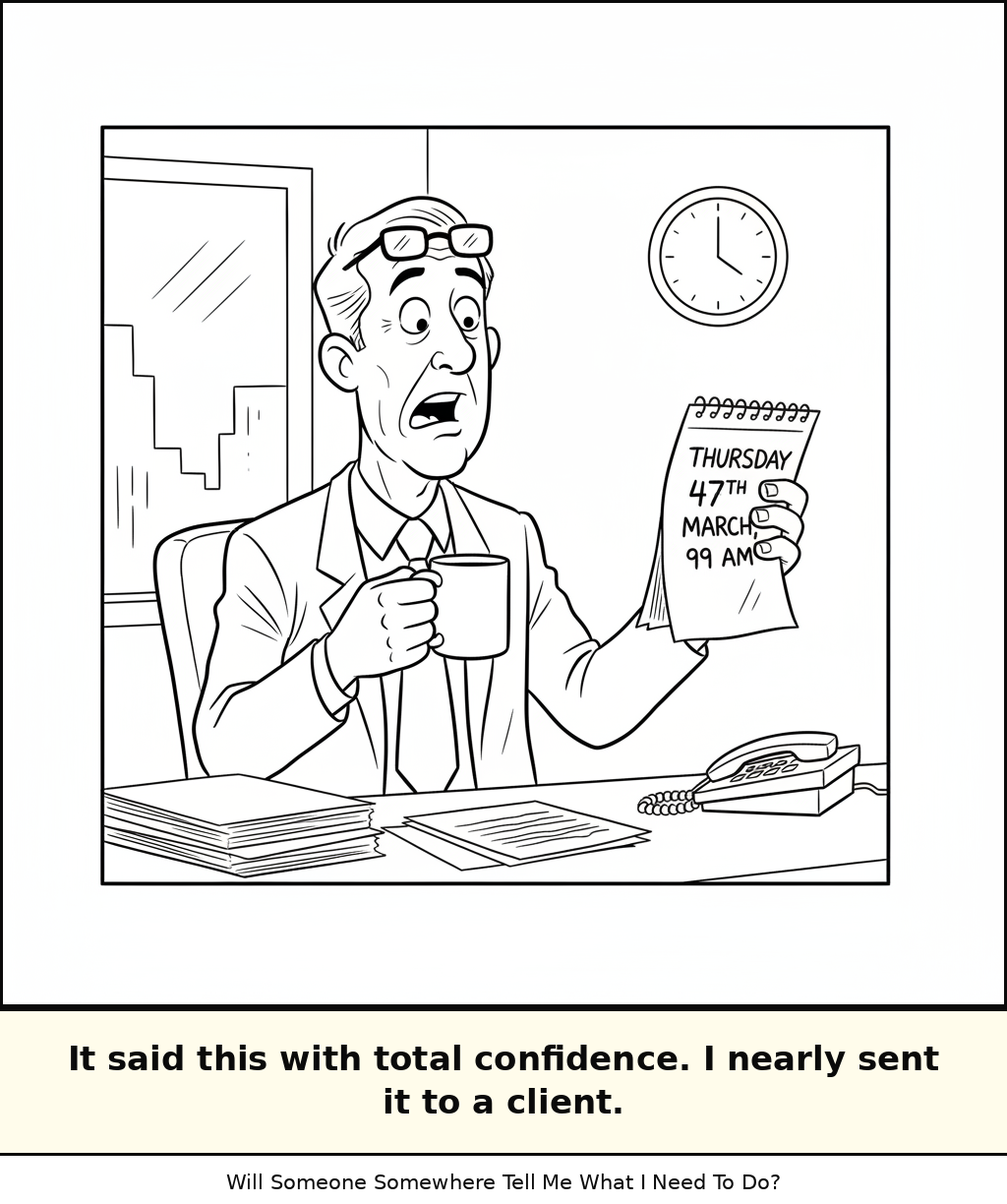
"It said this with total confidence. I nearly sent it to a client."— Office Man
What is it?
AI tools sometimes produce output that is fluent, specific, and completely wrong. A date that does not exist. A statistic from a source that was never written. A person attributed a quote they never said. This is called hallucination — not a malfunction, but a feature of how these systems work. Large language models predict plausible text. They do not verify facts before producing them. There is no internal alarm that fires when they generate something false. The output looks and reads like reliable information. It may not be.
Why now?
As AI tools move into professional work — client documents, research summaries, meeting notes, reports — the consequences of unverified output go up. A hallucinated fact in a draft you kept to yourself is a minor irritation. A hallucinated statistic in a document sent to a client is a problem. The tools are being used for more consequential tasks, so the failure mode that was always there is now landing in places where it matters.
The human angle
The uncomfortable part of hallucinations is that they exploit the way we read. Fluent, well-structured writing carries implicit authority. If a paragraph is grammatically clean and confident in tone, we tend to assume it is reliable. AI output is always fluent and confident. That surface quality tells you nothing about accuracy. The person most likely to catch a hallucination is the one who already knows the answer — which is exactly the situation where you were hoping the AI could help.
What to do
Treat AI output as a draft. The AI is good at generating structure and language. You are responsible for the facts. Before any AI-assisted document leaves your hands, identify the specific claims — dates, names, figures, citations — and check them. Ask the AI to cite sources when relevant, then verify those citations exist. Build this check into your workflow rather than relying on memory. This takes less time than explaining a mistake. The division of labour works: AI for fluency, you for accuracy.