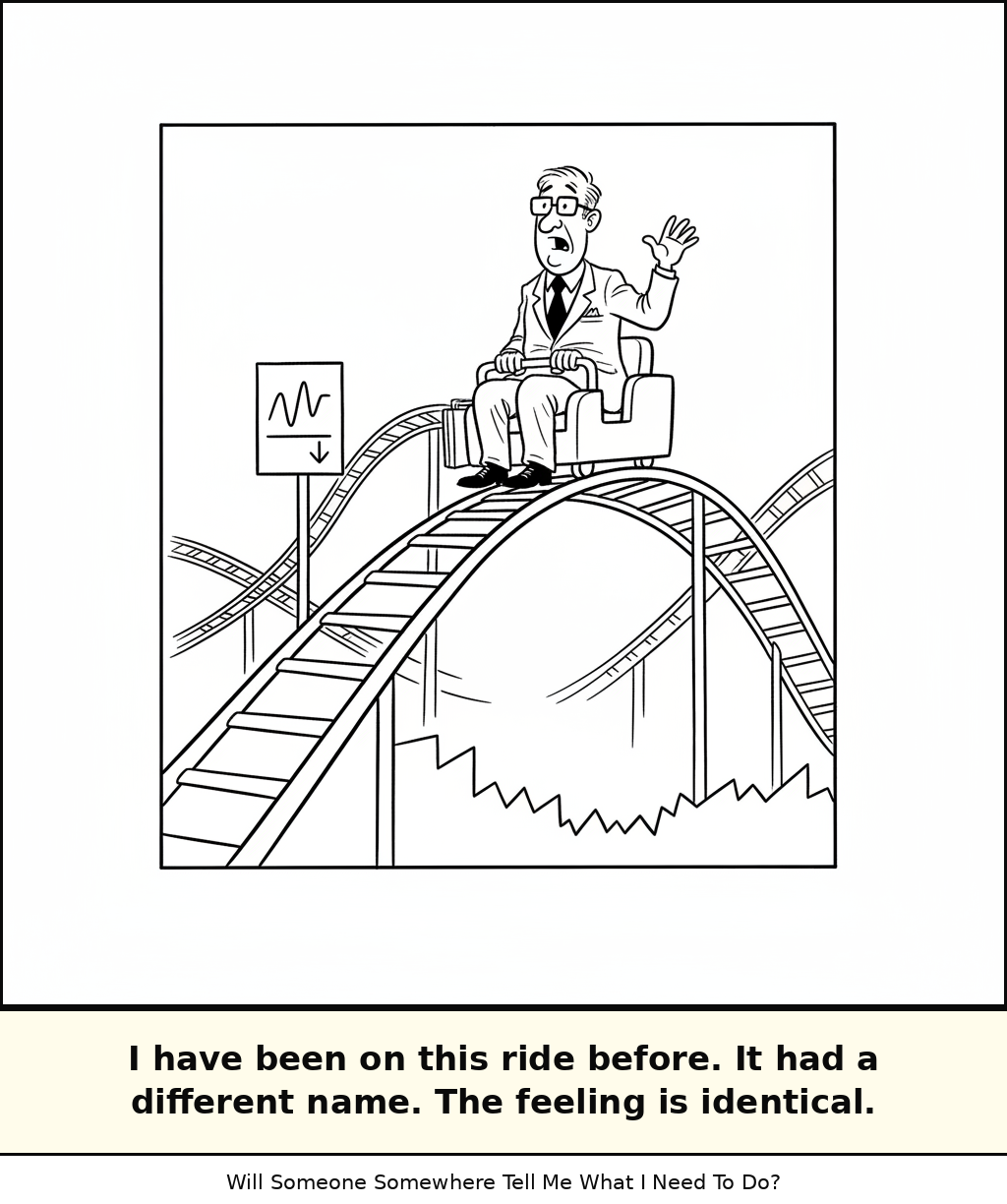
"I have been on this ride before. It had a different name. The feeling is identical."— Office Man
What is it?
The hype cycle is a concept from Gartner describing how new technologies move through stages: a trigger of early interest, a peak of inflated expectations, a trough of disillusionment, a slope of enlightenment, and finally a plateau of actual productivity. We have seen this with the internet, with big data, with blockchain. AI is following a similar curve. The technology is real. The capability is genuine. The timeline of what it will do and when is being significantly overstated. These two things are both true at the same time, and holding both is the key to making sensible decisions.
Why now?
The release of ChatGPT in late 2022 produced one of the fastest technology adoption curves on record. Enormous financial investment followed. Media coverage has been relentless. The result is a situation where people are making significant decisions — about investment, about strategy, about their own careers — based on a signal that contains a great deal of noise. This matters because organisations that invest heavily at the peak of the hype curve, based on the most optimistic claims, often find themselves disappointed. Not because the technology is useless, but because expectations were set by enthusiasm rather than evidence.
The human angle
The hype cycle is exhausting if you take it seriously. Every week brings a new announcement, a new claim, a new counter-claim. The people most exposed to this are those whose job it is to keep up — and many of them are visibly fatigued. For everyone else: the anxiety this produces is not always proportionate to the actual near-term impact on your work. The most useful things you can do with AI today are mundane — drafts, summaries, meeting notes. The transformative applications are developing more slowly than the coverage suggests. That is fine. It means you have time to build useful habits before the stakes get higher.
What to do
Separate near-term products from research-stage capability. When something is announced, ask whether you can use it today in a reliable way — not whether it is impressive. Ask whether anyone doing work like yours has found it genuinely useful, and for what. Give yourself permission to wait six months on anything announced this week: if it is real, it will still exist. Focus on what is available now and mature enough to build habits around. And resist both poles — the euphoria that says everything is about to change, and the dismissal that says nothing is real. Both are wrong.