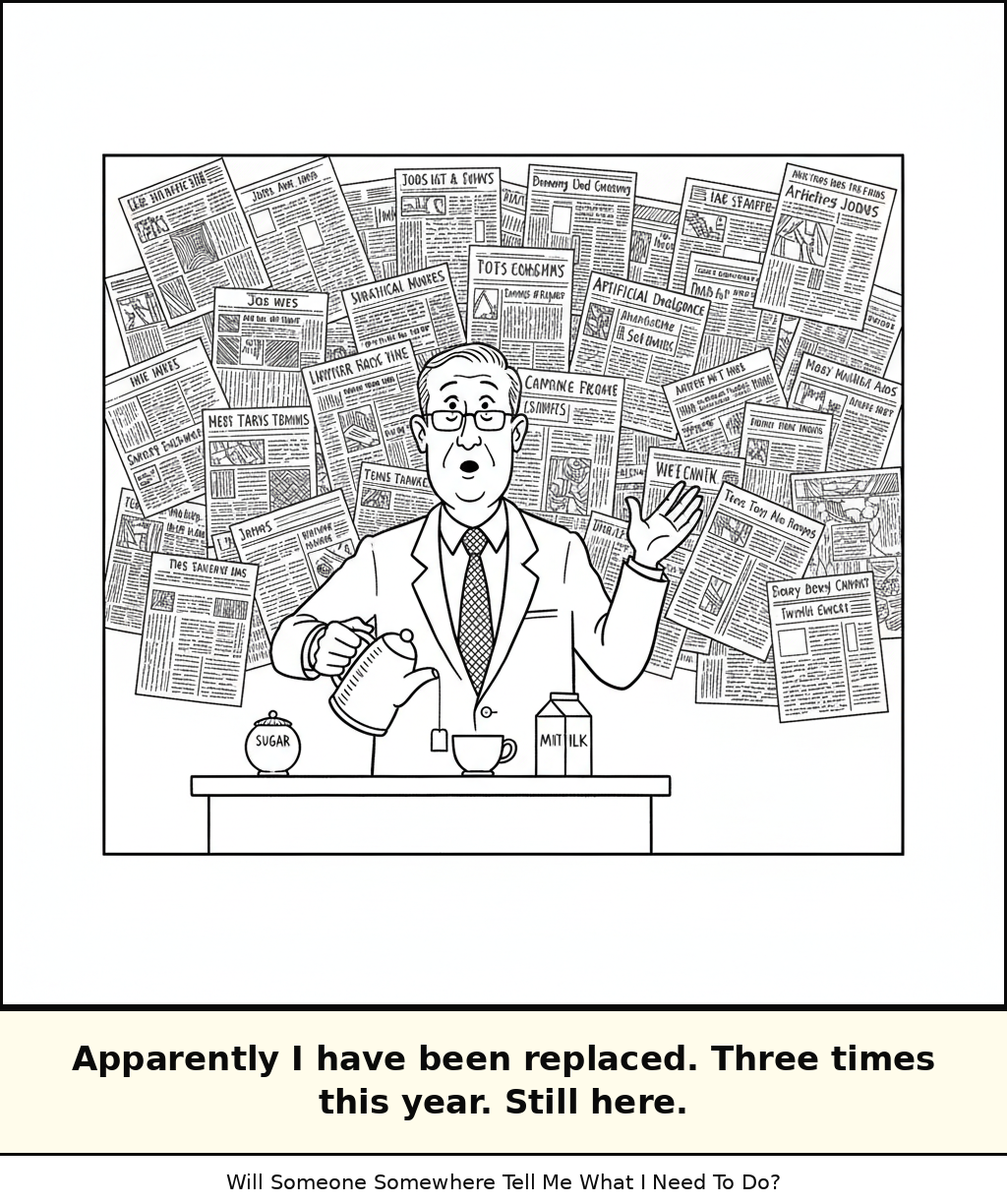
"Apparently I have been replaced. Three times this year. Still here."— Office Man
What is the actual claim?
AI is automating tasks within jobs — not eliminating jobs wholesale. Every role is a collection of tasks. The tasks most likely to change are the ones that are routine, measurable, and primarily digital: basic data entry, structured document processing, standardised content moderation, predictable query handling. The jobs where most of the work is this kind of task are the ones facing the most genuine disruption. For most knowledge workers, the job continues — but what it contains is slowly shifting.
Who is actually affected first?
The roles and sectors seeing real change are those where output is primarily text or structured data, follows predictable patterns, and comes in high volume. Translation services, routine paralegal document review, basic customer support query triage, some junior content roles. These are real changes. But they are specific. The general headline — "AI is replacing workers" — describes a real thing in a misleadingly undifferentiated way. The change is happening at different speeds in different sectors, and the part most likely to change in most roles is a subset of tasks, not the role itself.
What holds up?
Work that requires integrating ambiguous information, building trust with specific people, making consequential decisions under uncertainty, or navigating genuinely complex situations is more durable — not permanently, but for now. These are not mystical qualities. They are specific kinds of task. If you look at your own job and think about which parts require you to read a situation that is not clean or well-defined, those parts are the least affected by current AI capability. Identifying them is useful. It tells you where to put your energy.
What to do
Look at your own job task by task. Identify which parts are most routine and most digital — those are the ones most likely to change. Follow your specific sector rather than general AI-and-jobs narratives: the picture in healthcare administration is different from the picture in media, which is different from the picture in software development. Build skills around judgement, relationships, and context. Use AI tools to handle the routine parts of your current work — this is useful practice and it frees your time for the parts that are harder to automate.